
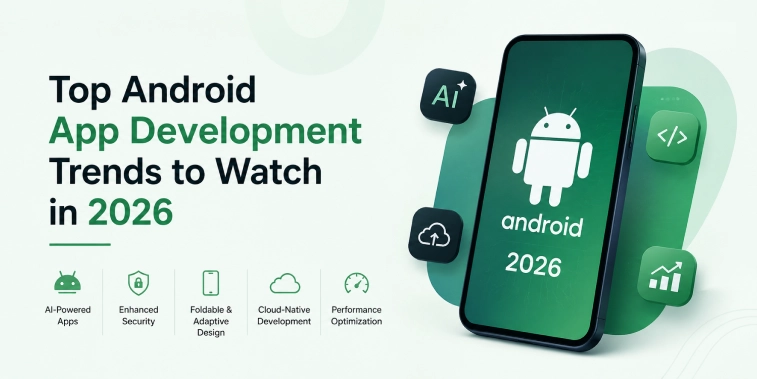
Top Android App Development Trends to Watch in 2026
Introduction
Android still rules the world of mobile devices, running on millions of mobiles, tablets, smart TVs, wearables, and Internet of Things devices. Companies that are still moving towards their digital transformation are implementing Android app development.
In 2026, consumers will no longer be satisfied with just useful smartphone applications but will expect smart, quick, safe, and personalized devices. With the help of modernization trends like Kotlin Multiplatform and Jetpack Compose, it is possible to develop applications that would satisfy new consumer requirements.
Whether you’re a startup business launching the first mobile app or an established enterprise upgrading existing ones, staying abreast of developments in Android development will put your business ahead of rivals. Thus, using new technologies means improved customer satisfaction rates, boosted performance and security, more scalability, and enhanced ROI.
This article looks into the most crucial technological trends to follow in the world of Android app development in 2026.
What is Android app development?
Android application development is the development of mobile apps for devices running the Google Android operating system. To create high-quality applications, developers use different applications like Android Studio, programming languages like Java, Kotlin, etc., and Google’s “Android Software Development.”
Android applications serve businesses across nearly every industry, including:
- eCommerce
- Healthcare
- Finance
- Education
- Logistics
- Food Delivery
- Travel
- Entertainment
- Real Estate
- On-Demand Services
Current Android development isn’t constrained only to mobile devices anymore. Mobile app developers create apps not only for:
- Foldable smartphones
- Tablets
- Wear OS smartwatches
- Android TV
- Mobile infotainment devices
- Domestic gadgets
The Android network keeps on growing, making it one of the most adaptable frameworks for companies wanting to have a worldwide reach.
Why People Choose Android
Companies prefer the Android because it provides numerous benefits:
- Large global user base
- Open-source environment
- Flexible customization options
- Fast innovation
- Low publishing prices
- Broad device compatibility
- Simple integration with Google services.
The above-mentioned benefits make Android an ideal platform for businesses wanting to approach customers in an economically efficient manner.
The Accelerating Pace of Android App Development
The mobile industry is now witnessing one of its fastest and most innovative periods. As a result, “In today’s age of fierce competition, customers are becoming increasingly more demanding. Companies are investing a large amount of money in digital experiences to remain highly competitive in the market.
There are a number of essential reasons for the rapid development of Android applications in 2026.
Artificial Intelligence is Becoming Standard
Artificial intelligence is changing how users communicate with mobile applications. With the advent of AI, users no longer manually go through menus of mobile apps; rather, they expect apps to grasp their known preferences, predict their actions, and offer them relevant recommendations.
AI-powered Android apps can:
- Recommend products.
- Automate customer support.
- Analyze user behavior.
- Improve search accuracy.
- Detect fraud.
- Translate languages in real time.
With the passing of time, AI will also become more accessible thanks to Google’s development tools, which let small enterprises include intelligent features in their systems.
Android Devices Are Becoming More Diverse
Android is no longer just a smartphone operating system.
In today’s world of technology, developers are creating new experiences for:
- Folding devices
- Wearable Technology
- Smart Television
- Car Technology
- Tablet Computing
- Internet of Things (smart devices)
The application should meet this requirement of compatibility.
Performance Expectations Continue to Rise
Users have little patience for slow-loading applications.
Modern Android apps are required to provide:
- Split-second startup
- Seamless transitions
- Low energy consumption
- Offline access
- Consistent performance
- Optimal resource usage
Google has not stopped releasing performance tools for Android app developers to make their apps.
1. Android Apps Powered by AI
Artificial intelligence in today’s Android application development is more of a necessity than an extra amenity.
By 2026, organizations are using AI to provide better, faster services. It is due to the Google AI ecosystem that consists of tools fueled by Gemini technologies and intelligence working on devices that help Android applications to carry out analysis of users’ behavior, automate routine operations, and give helpful suggestions.
Why It Is Necessary to Use AI
There has been a rise in user anticipation of apps performing predictive tasks rather than awaiting input from users. Thanks to AI, apps can carry out data processing thoroughly and instantaneously, therefore making their services tailored to a user’s desires.
For example:
- Shopping apps recommend products according to the browsing history.
- Banking apps find suspicious transactions.
- Healthcare apps monitor health trends for patients.
- There has been an improvement in the accuracy regarding preparation and delivery time estimates in food delivery applications.
- Travel applications offer personalized suggestions for travel itineraries.
These smart features help with customer satisfaction and engagement and retention.
Popular AI Features in the Android App
Businesses are coming together:
- AI chatbots
- Voice assistants
- Personalized recommendations
- Smart notifications
- Predictive search
- Image recognition
- Text generation
- Real-time translation
- Fraud detection
AI is rapidly moving from a premium feature to a competitive advantage.
2. Jetpack Compose Is Becoming the Leading UI Technology
The last few years have seen changes in UI design. A toolkit with which Android UI gets developed called Jetpack Compose is taking over the conventional XML-based designs.
Jetpack Compose lets you build UIs easily by leveraging declarative programming and thus limiting the code needed to build interactive UI.
Advantages of Jetpack Compose
Jetpack Compose offers more than traditional XML layouts:
- Rapid UI development
- Less boilerplate code.
- Enhanced readability
- Simpler servicing
- Improved animations
- Preview this book
- Enhancing productivity
Thanks to Jetpack Compose, developers can speed up the process of user interface development due to which the time spent on application development is minimized and costs are cut.
Better user experience
Today’s users expect smooth animations, responsive layouts, and appealing visuals.
Jetpack Compose supports:
- Material Design 3
- dynamic themes
- adaptive layouts
- animation (responsive)
- accessibility improvements
This makes it possible for companies to create quality mobile solutions that help them make their customers happy
3. Kotlin Multiplatform Advancement
Being the first choice programming language for Android development, Kotlin has evolved into Kotlin Multiplatform (KMP), which changes the mobile application development processes altogether.
Instead of keeping different business logic for both Android and iPhone, developers can utilize the process of sharing some core code across the platforms and making native UIs at the same time.
Why Businesses Are Adopting Kotlin Multiplatform
Kotlin Multiplatform helps organizations:
- Reduce development costs
- Accelerate project timelines.
- Improve code consistency.
- Simplify maintenance.
- Share business logic.
- Maintain native performance.
The result of this method is that businesses can launch products more quickly without sacrificing the usability of the platforms.
Ideal Use Cases
Kotlin Multiplatform works well for:
- Banking applications
- Healthcare apps
- eCommerce platforms
- Productivity tools
- Travel apps
- Networking sites
With the development of cross-platform technology, Kotlin Multiplatform will likely gain popularity as a choice for corporate mobile projects.
4. Edge AI and Machine Learning on the Device
One of the important trends of Android in 2026 is the introduction of Edge AI, which entails the operation of a machine learning model on the users’ device, not on cloud servers.
This trend has proven to be effective since the operation on Edge AI brings about speed, reliability, and a minimum of Internet dependency.
Pros of On-Device AI
As keeping AI processes on-site has multiple advantages:
- Quicker response
- Enhanced confidentiality
- Minimal latency
- Ability to work offline
- Less expensive cloud services
- Optimized battery use
Users can get their answer much faster without exposing their data to external servers.
Common Applications
Android developers are increasingly using on-device machine learning for:
- Face recognition
- Document scanning
- Barcode reading
- Voice recognition
- Language translation
- Object detection
- OCR (Optical Character Recognition)
- Image enhancement
ML Kit and TensorFlow Lite from Google make the integration of these features easier for software developers in their apps.
5. Foldable & Multi-Screen Application Experiences
Foldable smartphones have become popular, and Android developers must create applications that will allow changing the screen size and orientation.
Foldable devices differ from regular smartphones, as they provide exclusive user interactions that require such apps to have flexible design and interfaces.
Importance of Foldable Optimization
Users desire the ability to use apps smoothly on foldable devices, no matter if they are in a folded or unfolded position.
The benefits of foldable device optimization are
- Enhanced multitasking
- Better efficiency
- Greatly improved media consumption
- Flexibility in design
- Better gaming experience
Upgrading to accommodate foldable devices would allow businesses to offer easier and more interactive experiences to their clients.
Best Practices
Developers need to put more emphasis on:
- Adaptive layouts
- Responsive design
- Multitasking capabilities
- Flexible navigation
- Ongoing app state management
- Optimized media scaling
After putting these practices into consideration, developers can achieve better performance on an increasing variety of Android devices.
6. Android 17: Driving Android App Development in 2026
Android 17 leads Android app development in 2026, introducing the most advantageous features that allow developers to come up with applications in a much faster, better, and more secure manner.
Android 17 comes with improved artificial intelligence (AI), superior privacy options, better functionality, and compatibility with folding devices. All this enables companies to design unbeatable mobile solutions by means of Android applications.
Key Android 17 Features
- Enhanced AI integration
- Improved privacy and security
- Better battery optimization
- Faster app performance
- Advanced developer APIs
- Improved foldable device support
- Better accessibility features
- Optimized app compatibility
Importance of This Development
The use of Android 17 enables entrepreneurs to create effective Android applications, provide a seamless user experience, enhance the protection of data, and ensure compliance with modern gadgets and regulations of Google Play.
7. Super Apps & Multi-Service Platforms
Super apps became quite popular in the year 2026. Rather than using several applications to accommodate various requirements, customers prefer using one super app, which provides it all.
Super apps provide various services to consumers in one place, while at the same time facilitating their daily life and enhancing their level of interaction with the brand.
Why Super Apps Are Trending
Present-day consumers appreciate convenience. Instead of using several different applications to get transport, shop, or order food, they prefer to have a seamless experience.
Common Services in Super Apps
A modern Android super app may include:
- Ride-hailing
- Food delivery
- Grocery delivery
- Pharmacy delivery
- Courier services
- Home services
- Beauty appointments
- Online payments
- Wallet integration
- Video consultation
- Hotel booking
Business Benefits
Developing a super app offers several advantages:
- Higher customer retention
- Multiple revenue streams
- Cross-selling opportunities
- Increased daily active users
- Better customer data insights
- Improved brand loyalty
As the expectations of customers are changing, super apps are expected to be among the fastest-growing Android app categories in the near future.
8. Wear OS and Smart Devices
The evolution of wearable technology has gone far beyond mere tracking of fitness data. Smartwatches today can provide capabilities such as messages, health status monitoring, navigation, and online payment, as well as the creation of voice commands.
There is a growing trend among Android programmers to create software that works with Wear OS gadgets.
Increased Need for Wearable Apps
Users anticipate the availability of connected solutions on their smartphones, smartwatches, tablets, and other smart gadgets.
The most popular types of wearable apps correspond to the following categories:
- Fitness tracking
- Heart rate monitoring
- Sleep analysis
- Medication schedule reminders
- Contactless payments
- Smart notifications
- Voice commands
- GPS navigation
Business prospects in various sectors are numerous.
Healthcare professionals have many opportunities to track patients from a distance.
Fitness companies can offer individual training programs.
Retail companies can create offers based on customer location.
Financial companies can facilitate payment through a smartwatch.
The creation of Android applications compatible with wearables helps companies to increase interactions with customers while establishing the digital ecosystem.
9. Stronger Mobile Security
As mobile applications are capturing sensitive data, Android developers have turned their attention to how secure these apps are.
The risk of cybersecurity attacks is increasing as the demand for cybersecurity rises in order to provide safety of the data in use.
Key Security Trends in 2026
Modern Android applications now implement:
- Biometric authentication
- Passkey login
- End-to-end encryption
- Secure API communication
- Multi-factor authentication
- Token-based authorization
- Runtime threat detection
- Data encryption
Privacy-First Development
- Users are becoming more aware of data privacy.
- The following points should be taken into consideration by companies:
- The establishment of a clear privacy policy
- The limitation in the data collected
- Ensuring data safety in the cloud
- Managing consent properly
- Following the privacy laws in practice
Creating secure Android products helps both users and brands by increasing their reputation and minimizing the likelihood of expensive security mishaps.
10. Integrating AR & VR
Mobile industries are being enriched by the emergence of Augmented Reality (AR) and Virtual Reality (VR).
As a result of better Android hardware and software support, it now becomes easier for companies to apply the AR and VR features within their apps.
Popular AR Applications
- Android apps use AR for:
- Virtual furniture placement
- Beauty product try-ons
- Interactive education
- Indoor navigation
- Product visualization
- Real estate property tours
Sectors Gaining from AR and VR
Numerous businesses are adopting immersive technologies:
- Retail
- Healthcare
- Education
- Gaming
- Manufacturing
- Tourism
- Architecture
- Real estate
These technologies help to enhance the engagement of customers while assisting businesses to get recognized in competitive markets.
11. Android Applications Fueled by IoT
The flourishing of the Internet of Things (IoT) is remarkable, as it unites devices globally.
The Android applications are at the forefront of controlling this connected system.
Examples of IoT Applications
Businesses develop Android apps for:
- Smart homes
- Connected vehicles
- Industrial equipment
- Healthcare monitoring
- Smart agriculture
- Energy management
- Security systems
- Manufacturing automation
Business Advantages
- IoT-powered Android apps provide:
- Real-time monitoring
- Remote device control
- Predictive maintenance
- Reduced operational costs
- Better customer experiences
- Improved operational efficiency
The battle for IoT integration with smart devices will be one of the priorities in Android application development.
12. 5G & Real-Time Experiences
5G networks are being rolled out across the globe and change how mobile applications function by providing them with unprecedented speed and reduced latency, which is a change that favors the developers.
As 5G is starting to become implemented, developers of Android technology are now making use of real-time communications in applications that also maintain speed.
Advantages of 5G
5G technology allows Android applications to provide users:
- Streaming in Ultra-HD
- Gaming via the cloud
- Consultations over video in real-time
- Collaboration in real-time
- Synchronization of files in real-time
- Managing downloads faster
- Playing better multiplayer games
- Making video calls in high quality
Industries Benefiting from 5G
Businesses across various industries are leveraging 5G technology, including
- Healthcare
- Education
- Logistics
- Entertainment
- Finance
- Retail
- Transportation
5G and artificial intelligence have come together so as to create the next generation of smart apps for Android.
Essential Android Development Technologies in 2026
The development environment covers a broad segment of tools, frameworks, and related cloud services from which modern Android apps are built.
Some of the most relevant technologies are
| Technology | Purpose |
| Kotlin | Modern Android programming language |
| Android Studio | Official IDE |
| Jetpack Compose | Modern UI toolkit |
| Firebase | Backend services |
| Room Database | Local data storage |
| Retrofit | REST API communication |
| GraphQL | Efficient API queries |
| ML Kit | Machine learning features |
| TensorFlow Lite | On-device AI |
| Google Maps SDK | Maps and navigation |
| Firebase Cloud Messaging | Push notifications |
| CameraX | Camera integration |
Choosing which of these technology stacks to choose can be a huge worrying point because it mainly is the backbone of scalability, maintainability, and total application performance.
Benefits of Following the Latest Android App Development Trends
Whether it be for a new technology or to help a business grow or to satisfy existing customers with a new solution, keeping yourself up-to-date with the latest developments is vital, and that also is true in the Android development case.
Improved User Experience
The embraced modern frameworks with AI-powered capabilities are making these applications swift, seamless, and more informative to end users.
Higher Customer Retention
Users return again to personalized experiences, responsive interfaces, and reliable performance.
Better App Performance
More stable with optimized code for modern architectures—also better, more stable with better tools to keep you building with fewer crashes.
Increased Revenue
Additionally, advanced features result in better conversions: AI recommendations, in-app purchases, and subscriptions—these things are often found in successful apps, but Aiding app monetization.
Competitive Advantage
Earlier adopters of the emerging technologies usually establish stronger market positions compared to those using outdated solutions.
Future of Android App Development?
Artificial intelligence, cloud computing, and the connected devices will also change the Android development process after 2026 but with a different pace.
It is expected that numerous innovations will shape the development of technology:
- Mobile apps driven by AI
- Applications that can seek to take voice commands
- Smart and automatic computing
- Technologies related to extended reality
- Extremely unique customer experiences
- Mobile assistants
- Advanced technologies of wearable devices
- Better integration of IoT technologies
Experts in mobile technologies become better in developing Android apps with future orientation.
Conclusion
A new interesting age of Android application development is at hand. AI is okay with an experience, Jetpack Compose, Kotlin Multiplatform, Edge AI, Wear OS, and IoT. And 5G is changing the way businesses create and deploy applications.
Skipping ahead to 2026, enterprises that adopt these trends will be able to develop faster with enhanced security and scalability along with a better user experience as they launch or modernize Android apps. Be it an eCommerce platform, healthcare solution, fintech app, or on-demand service—no matter what your business/services entail in the future: Building with modern Android technologies will make sure that you build a product that is on par with the competitors and helps us navigate through this new digital world.
The future success of companies hinges on their focus on innovation practices, user-centered design, and how they find ways to constantly upgrade technology development. By following important changes and changes in the area of Android application development, you will create applications that will fully meet the current requirements but also be prepared for future events.
Frequently Asked Questions (FAQs)
1. What are the top Android app development trends to watch in 2026?
The Top Android APP Development Trends 2026 are AI-powered apps, Jetpack compose, Kotlin Multiplatform App (KMP), Android 17 Era, Edge Ai Technology In Mobile Apps development & IoT Integration To Wear OS support those who beacon potential of connectivity by strong feature along with security threats definition in mobile sector.
2. Here are the reasons why you should follow the Android app development trends.
Keeping abreast of the most recent Android app development trends truly enables enterprises to build robust and secure applications whilst being future-proof—thereby adding value to your customer experience and engagement.
3. Mobile Application Development: Trends that affect Android app development in 2026
Modern Android application development in 2026 is powered by Alphabet over Kotlin, Jetpack Compose, Android Studio, Firebase, TensorFlow Lite of the Google Brain division group that supports & promotes ML Kit (Machine Learning) at will through GraphQL by providing backendless support to mobile engineering teams and and/or automatic code refactoring into Android 17.
4. How do I choose the right Android app development company?
Select the company with demonstrated Android expertise and a good portfolio, experience in modern technologies (Kotlin for example), clear communication model as well as great post-launch support.
5. Why choose AndSwitch Tech for Android app development?
AndSwitch Tech specializes in custom app development company known for building Android apps that scale with the Google ecosystem using Kotlin, Jetpack Compose, AI-powered integration for scaling your solutions as well as amazing new-age UI/UX. We design, build and scale android apps that deliver targeted business impact from intelligent applications across and within enterprises.